Advantages of using drones for heavy lifting applications
April 6, 2026
|
Ben Hargreaves
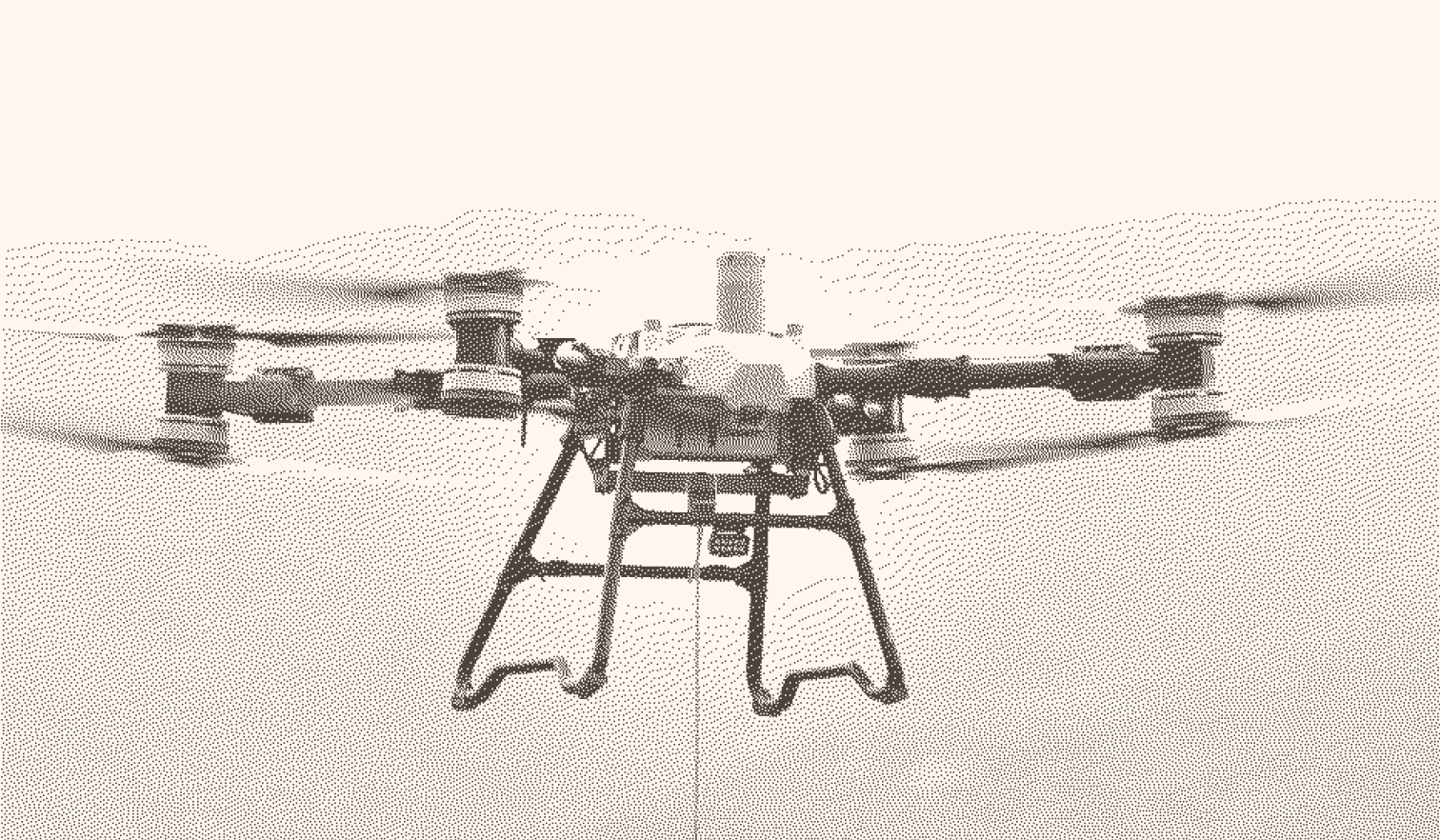
Whether you're managing an offshore wind turbine, running a remote forestry operation, delivering equipment to a high-level construction installation, or trying to get a cinema camera rig to an inaccessible location shoot — the logistics of precision payload delivery to difficult or dangerous locations is a persistent, expensive, and often underestimated problem.
Cranes require access, ground preparation, and significant day rates. Manned helicopters cost between £1,200 - £4,500 per flight hour before mobilisation, ground crew, and weather delays are factored in. Rope access works, but it is slow, weather-sensitive, and carries inherent risk for the operatives involved.
There is now a third category. And for lifts up to 100kg, it is frequently faster, cheaper, and safer than every alternative.
Why Heavy Lift Drones Work — The Case in Plain Numbers
The DJI T100 is a purpose-built heavy lift drone with a payload capacity of up to 100kg. It holds a hover position to centimetre-level accuracy, operates with full obstacle sensing, and can be deployed from a car park, a vessel deck, or a cleared patch of ground with a fraction of the setup time required by any other conventional lifting method.
Here is why it makes operational and financial sense:
- Cost: Hourly helicopter hire rates range between £1,200–£4,500. Drones cost only 20% of that — for precision payload tasks in the 25kg to 100kg range, the cost difference is massive.
- Mobilisation: No specialist access route, no large footprint, minimal ground preparation required.
- Precision: Centimetre-accurate delivery to defined GPS coordinates, repeatably, without loud rotor disruption or swing load risk — a standard cranes and helicopters simply cannot match.
- Reduced risk to personnel: The drone and equipment flies to the location without a human pilot onboard.
- Repeatable missions: Once a waypoint route is set, the same delivery can be flown multiple times efficiently without renegotiation or additional setup.
If your current approach to precision payload delivery involves a crane that needs lengthy setup and waits while your team works, a helicopter that can't quite land where you actually need it, or a rope access team doing what a machine should do — the economics of the T100 are worth examining seriously.
Heavy Lift Drones in Construction and Infrastructure
Applications:
- Antenna & telecoms mast installation
- Rooftop HVAC & mechanical delivery
- High-level facade access
- Curtain wall component delivery
- Bridge & viaduct inspection equipment
- Specialist fixing hardware
- Survey & monitoring equipment
Construction projects regularly generate a specific category of problem: a component or piece of equipment that weighs between 10kg and 100kg needs to reach a location that is high, awkward, or not safely accessible by conventional means. The instinctive solution is a crane.
A crane requires a rated access route, a hardstanding pad or outrigger plates, a significant operational radius clear of obstructions, and a day rate that applies whether the actual lift takes four hours or forty minutes.
For precision delivery of components to high-level installation points — antenna bases, rooftop service equipment, inspection rigs, structural fixings — a heavy lift drone solves the same problem faster, with a smaller site footprint, and without the access constraints.
Specific use cases where drone payload delivery outperforms crane hire:
- Installing telecoms and 5G antenna equipment on structures without crane-accessible hardstanding.
- Delivering replacement components to high-level MEP installations during live construction without disrupting ground activity.
- Getting surveying and monitoring equipment to roof level on occupied buildings where internal access is restricted.
- Delivering specialist fixings or medium-size mechanical components to steel erection teams working at height — eliminating trips down and back up.
The CAA regulatory framework for construction-adjacent drone operations in the UK is well established. Any competent operator will hold the appropriate permissions and be able to demonstrate compliance before work begins.
Heavy Lift Drones in Offshore Wind
Applications:
- Component delivery to turbine nacelles
- Inspection equipment deployment
- Tool & spares delivery to transition pieces
- Sensor package installation
- Cable & connector delivery
- Vessel-to-turbine equipment transfer
Offshore wind presents one of the clearest economic cases for heavy lift drone deployment anywhere in UK industry. The problem is structural: you have assets in the sea, those assets require regular maintenance and component replacement, and getting anything to the upper sections of a wind turbine involves either a service vessel with crane capability, rope access operatives working at significant height in hostile conditions, or a manned helicopter.
All three of those options are expensive. Two of them carry meaningful risk to personnel and none of them are particularly precise when it comes to placing a load at a specific point on a structure in a live marine environment.
The DJI T100 operating from a service vessel deck changes the equation for lifts up to 100kg. Sensor packages, cable assemblies, inspection rigs, specialist tooling, replacement electronic components — a substantial proportion of the day-to-day logistics burden on an offshore wind O&M programme falls within that payload envelope.
Where drone payload delivery adds measurable value in offshore wind O&M:
- Delivering replacement sensor packages and monitoring equipment to nacelle level without rope access or crane deployment.
- Transferring tools and small components from vessel deck to transition piece access platforms.
- Deploying inspection equipment — including thermal imaging payloads — to specific structural points.
- Reducing the number of vessel mobilisations required for component delivery tasks that fall below the threshold where full crane deployment is justified.
- Supporting operations in sea states and wind conditions where sending personnel to height carries elevated risk.
For offshore wind farm managers evaluating maintenance logistics costs, the question worth asking is: how many crane or helicopter deployments per year are being used for lifts that fall within a 100kg payload envelope? In most O&M programmes, the answer is enough to make the drone alternative a straightforward business case.
Heavy Lift Drones in Forestry & Re-Foresting
Applications:
- Remote equipment delivery
- Survey & monitoring placement
- Seed & treatment delivery
- Rigging component delivery
- Forestry machinery parts
- Access route bypass
- Sapling delivery
UK forestry — particularly in Scotland, Wales, and the upland areas of northern England — operates in terrain where access is frequently the primary operational constraint. Tracks take time and money to build. Vehicles have weight and gradient limits. Crews working in remote sections of a harvesting block regularly need equipment, parts, and consumables that cannot reach them quickly by conventional means.
Heavy lift drones can also help with re-foresting, carrying saplings directly to their planting location — no matter how steep the terrain.
A heavy lift drone operating from a cleared area at the forest edge or road head can deliver up to 100kg to a GPS-defined point anywhere within its operational range — without a track, without a vehicle, and without requiring the crew to stop working.
Where heavy lift drones solve real forestry logistics problems:
- Delivering harvester or forwarder parts to remote breakdowns without waiting for a tracked vehicle or ATV to navigate difficult terrain.
- Delivering saplings or materials directly to planting locations that ground teams would struggle to access efficiently.
- Getting survey and remote sensing equipment to monitoring locations on steep or inaccessible ground.
- Delivering rigging components, chainsaw parts, and consumables to crews working in areas not yet connected to the extraction route.
- Bypassing waterlogged or seasonally impassable ground that would require significant track improvement to traverse by vehicle.
For forestry contractors and estate managers working in challenging upland terrain, the calculation is straightforward: what does it cost per hour to have a crew member walk to collect equipment or material, versus what it costs to fly it in?
Heavy Lift Drones in Film and Television Production
Applications:
- Large format cinema aerial work
- Remote location equipment delivery
- Aerial stabilised camera rigs
- Props & costume delivery
- Challenging terrain logistics
- Unit supply — road-inaccessible locations
The film and television industry already has a mature relationship with camera drones. The question that is now being asked on larger productions is not whether a drone can carry a camera — it is whether a drone can carry this camera, to that location, in these conditions.
For large format cinema work, the payload demands are significant. A fully rigged large format camera system with lens, stabilisation, and power can exceed 30kg. The DJI T100's payload envelope makes aerial large format acquisition viable in a way that smaller platforms cannot support, and with a level of transport stability that directors require.
Beyond camera work, production logistics on location shoots is an underserved application with an obvious cost case. Remote locations chosen for their visual qualities are, by definition, frequently difficult to access. Getting equipment, props, costume, or catering supplies to a unit working three miles from the nearest road by any conventional means involves significant time, cost, and in some cases, meaningful risk.
Where heavy lift drone capability adds value on production:
- Aerial work with large format cinema cameras and heavy stabilised rigs.
- Delivering equipment, props, or supplies to location units working in terrain inaccessible or impractical for vehicles.
- Supporting second unit operations in remote locations where full logistics mobilisation is disproportionate to the task.
- Reducing turnaround time when replacement equipment or additional kit is needed mid-shoot at a remote location.
- Providing a precision aerial delivery capability for time-critical production logistics.
Productions that build drone logistics capability into their planning from the outset consistently find it changes what locations are feasible, what the call sheet looks like, and what contingency options exist when things change on the day.
Common Questions About Heavy Lift Drone Operations
"Are heavy lift drone operations regulated in the UK?"
Yes. Commercial drone operations in the UK are regulated by the Civil Aviation Authority under the UK's Specific Operations Risk Assessment (SORA) framework. Operators carrying payloads commercially require at minimum a General Visual Line of Sight Certificate (GVC), with additional permissions required for operations in controlled airspace, beyond visual line of sight, or over congested areas. A credible operator will hold the appropriate authorisations and be able to present them before any work begins.
"What about payload security? How do you know the load won't drop?"
The T100 uses a dedicated payload attachment and release system designed specifically for precision delivery operations. Loads are secured prior to flight and the release mechanism is software-controlled, not mechanical, meaning unintended release is not a realistic failure mode. Redundant motor configuration means that partial motor failure does not result in loss of flight control. Any operation carrying a payload over people or critical infrastructure requires specific risk assessment and authorisation, and a competent operator will have both.
"Are heavy lift drones really cheaper than cranes?"
For lifts in the 25kg to 100kg range, consistently yes. When the full cost of crane deployment is accounted for in both time and money lost. That includes mobilisation, access preparation, the crane operator's time during setup and waiting periods, and the cost of any access route improvements or hardstanding required. Crane hire on a day rate is cost-effective when you're lifting multi-tonne structural elements repeatedly throughout that day. It is considerably less cost-effective when you are lifting a few 80kg components, to a specific point, on a structure where the crane cannot actually land adjacent to the delivery point.
"What weather conditions can heavy lift drones actually operate in?"
The DJI T100 has a rated maximum wind speed resistance of 12 m/s (approximately 27mph). That covers a significant proportion of UK operational windows. Offshore operations require site-specific assessment, and any reputable operator will not fly outside the platform's rated envelope. The honest answer is that wind is a constraint — but it is a constraint with known parameters, not the open-ended uncertainty of a manned helicopter weather hold.
Work With the UK's 1st Heavy Lift Drone Operator
Really Big Drone Company is the first operator in the UK to deploy the DJI T100 commercially, with the operational authorisations, technical expertise, and cross-sector experience to deliver the service you need.
If you have a project with a precision payload challenge we can give you a straight assessment of whether a drone is the right tool and what it will cost.
Ready to explore what heavy lift drone operations could mean for your project? Contact us below!